Kaye’s NIH award to leverage machine learning for tobacco treatment

UW-CTRI Researcher Dr. Jesse Kaye was awarded a K23 grant, a major career milestone, from the National Institute of Health’s (NIH) National Institute of Drug Abuse. Kaye will explore how machine learning (a subfield of artificial intelligence, or “AI”) might help to personalize treatment in real time for people trying to address their tobacco use.
“Personalized treatment is a promising strategy that may enhance the effectiveness of stop smoking therapies and deliver the right support for a particular person at a particular time in the quitting process,” Kaye said.
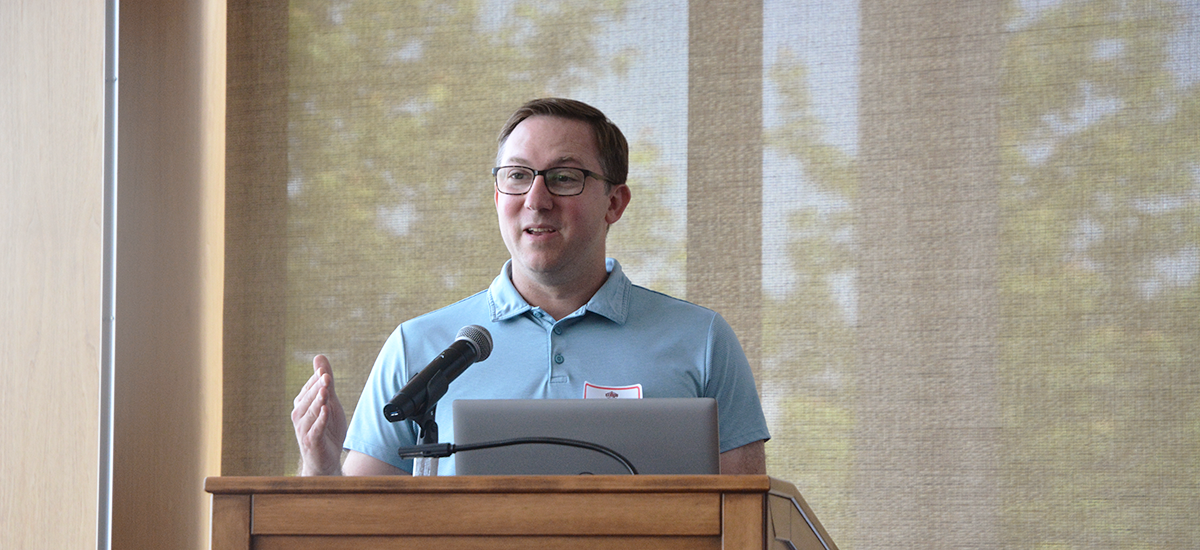 “Machine learning could help us develop sophisticated models to predict not just the outcomes of quit attempts, but also each person’s unique risks for lapse at any moment. The machine learning approaches developed in this project will inform hypotheses about when, how and for whom to deliver personalized treatment planning and real-time interventions to help people quit smoking.”
The only widely adopted precision medicine approach in tobacco treatment is tailoring nicotine replacement therapy dose to smoking heaviness. Kaye believes we can do better than that.
“Digital health tools have tremendous potential to enhance personalization of tobacco treatment,” Kaye said. “It can also facilitate delivery of support that’s relevant to a patient’s needs when needed most.”
Machine Learning Training
The purpose of a NIH K23 award is twofold. First, a rising investigator like Kaye gets additional mentorship and training. UW-CTRI Research Director Dr. Danielle McCarthy is Kaye’s primary mentor. His other mentors are Dr. John Curtin of UW Psychology Department and Dr. Michael Businelle of the University of Oklahoma, who have led research using machine learning approaches to improve addiction treatment.
“I’m so excited to dive into training on machine learning and to learn from all three of these terrific mentors,” Kaye said.
Kaye will also collaborate with UW experts in theory and data analysis: Dr. Tim Baker, UW-CTRI Associate Director and frequent UW-CTRI collaborators Dr. Wei-Yin Lo, Professor of Statistics and Dr. Dan Bolt, Professor of Educational Psychology.
UW–Madison is at the leading edge of innovations in data science. The state-of-the-art Morgridge Hall, which opened in August 2025, is home to the UW School of Computer, Data & Information Sciences and the Data Science Institute – the hub for high-tech research, learning and collaboration.
Kaye said UW–Madison is the ideal environment to conduct research at the intersection of tobacco treatment and data science.
Personalized Tobacco Treatment Research
This research will rely on data from more than 3000 adults who participated in prior clinical trials led by Baker at UW-CTRI or Businelle at Oklahoma. In these studies, participants tried to quit smoking while using different types of treatment – including medication, counseling and/or smartphone apps.
“Participants provided very rich information about themselves,” Kaye said, “including assessments of individual differences and ecological momentary assessments. They completed brief surveys on their smartphones over weeks to months after their quit day.”
Aim 1: Use machine learning methods to train, validate and test a long-term smoking relapse prediction model based on baseline (pre-treatment) assessments.
Kaye hopes to use machine learning to create algorithms that could quickly analyze complex data about a person at the beginning of treatment to identify their biggest risk and protective factors that predict how likely they are to succeed in quitting smoking.
This information could then be transformed into a ready-to-use personalized treatment plan – tailored to their specific individual strengths and challenges. Machine learning models could potentially help clinicians select the right medication for each patient (such as varenicline vs. nicotine replacement therapies), building on prior research collaborations between Curtin’s lab and UW-CTRI.
“This research is exciting because of the potential to eventually develop AI-assisted digital treatment planning tools that could be used in a variety of treatment settings,” said Kaye.
“For instance, this approach to identifying personalized modifiable risk factors could be implemented to guide coaching protocols in state tobacco quitlines, such as the Wisconsin Tobacco Quitline. Or, these decision support tools could be embedded in electronic health records to guide treatment planning in primary care clinics or other healthcare settings.”
“Being able to identify patients’ unique challenges at baseline that actually predict their long-term quit smoking success could help us develop more effective treatment plans,” Kaye said.
Aim 2: Use machine learning methods to train, validate and test a daily smoking-lapse-risk prediction model based on baseline and dynamic risk signals.
As treatment progresses, digital tools may help detect changes in risk to facilitate personalized treatment adjustments or “just-in-time” interventions.
Participants in many UW-CTRI smoking cessation clinical trials have completed daily smartphone surveys that assess factors that may be related to their success in quitting cigarettes. These assess when people were abstinent or smoking and time-varying risk factors (such as craving, stress, pain, cannabis use) and protective factors (such as self-efficacy or medication adherence).
“Sophisticated, high-dimensional data analytic approaches are needed to account for the complexity and intersecting influences on smoking lapses during quit attempts,” said Kaye.
“Machine learning will allow us to identify the dynamic patterns and features of individuals, events and contexts that prospectively predict smoking during quit attempts.
The first step is to develop reliable and precise predictions of future smoking likelihood (such as lapses). Once we accomplish that goal of prediction, our future research will aim to understand how best to communicate that feedback regarding lapse risk. We’ll also work to identify tailored interventions to address the person’s unique risks in the moment.
“I’m grateful that this NIH K23 will provide five years of funding to support our goal to ultimately develop novel personalized feedback interventions that can efficiently provide the right treatment, for the right person, at the right moment in time.”
This research is funded by the National Institute on Drug Abuse of the National Institutes of Health under award number K23 DA063870 (PI: Jesse Kaye, PhD).